



Romanian companies with strong financial performance can achieve Credit Ratings above Romania’s sovereign Rating, while geopolitical risks and growing international exposure are reshaping how European businesses are assessed. Speaking at the 2026 Gala by ARIR – Investor Relations Awards, Myrto Kyriakidou, Head of ICAP CRIF Ratings Agency, explained why Credit Ratings must combine financial data, forward-looking analysis and human judgement, and why investor relations professionals play an essential role in communicating the story behind a company’s numbers.
“A company’s creditworthiness is not necessarily constrained by the sovereign Rating of the country in which it operates.” This was one of the central messages delivered by Myrto Kyriakidou, Head of ICAP CRIF Ratings Agency, during the 2026 Gala by ARIR – Investor Relations Awards.
Addressing representatives of listed companies, investors and capital market professionals present at the Gala, Kyriakidou discussed the European Credit Rating industry, the financial resilience of Romanian companies, the impact of geopolitical risks and the importance of independent credit assessments.
“Very often, we are asked as a Credit Rating Agency: if I am a business in Romania, and this is the Credit Rating of the sovereign, is this a cap? Do I have any chance of achieving a higher Rating?” she said.
“The answer is yes, obviously. One obvious example could be a company with strong export activity, but it is not only that.”
According to Kyriakidou, companies with strong financial results and sustainable business models can demonstrate creditworthiness that exceeds the sovereign Rating, even in challenging economic and political circumstances.
“Even in this difficult situation of political instability, there are great companies. I am sure that some of these companies are participating here today. There are great companies with very strong financial results, and thankfully, they can have their own strong growth path without such a strong dependency on the sovereign Rating,” she explained.
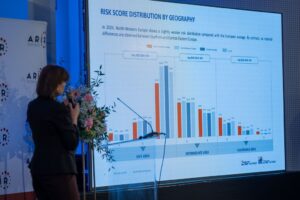
European credit risk: Why Northwestern companies show a weaker distribution
Kyriakidou also presented an analysis of European corporate credit risk based on financial statements collected through CRIF’s extensive business information databases.
The Italian CRIF Group operates across several areas of risk management, including business information, credit risk software and Credit Ratings. According to Kyriakidou, this combination gives its Rating agency access to data that can be used to calculate credit scores, develop sectoral benchmarks and compare companies across European markets.
“Being a Credit Rating agency with access to business information databases gives us this unique ability to benefit from the data, calculate scores and calculate sectoral benchmarks,” she explained.
One of the analyses presented during the event examined the geographical distribution of corporate risk scores across the EU-27, comparing Northwestern Europe, Central and Eastern Europe, and Southern Europe.
The 2024 results revealed an unexpected pattern: Northwestern European companies had a slightly weaker risk distribution than the European average, while Southern and Central-Eastern Europe showed no material differences from one another.
According to the presentation, 31.1% of Northwestern European companies were in risk category 3, compared with 40.6% in Central and Eastern Europe, 41.2% in Southern Europe and 37.8% across the EU-27. Category 3 belongs to the safest risk group in the methodology, which covers scores from 1 to 3.
At the other end of the distribution, 11.1% of Northwestern European companies were in category 6, compared with 7.2% in Central and Eastern Europe and 7.8% in Southern Europe.
“Northwestern European companies, in the safe area, have a lower percentage compared to Central and Eastern Europe and Southern Europe. This sounds counterintuitive, but there is an explanation,” Kyriakidou observed.
She attributed this difference partly to the stronger integration of Northwestern European businesses into global trade and international economic networks.
“Northwestern European businesses are more connected to global dynamics, to global trade. So every shock, whether it is the COVID pandemic or a geopolitical shock, is much more impactful in economies that are so globalised.”
She emphasised that this finding should not be interpreted as an argument against greater international integration for economies such as Romania, Bulgaria or Greece. Rather, it illustrates how global exposure can influence corporate risk profiles.
Geopolitical risk is particularly significant for manufacturing and transportation
Another part of Kyriakidou’s presentation focused on the CRIF Ratings Geopolitical Index, developed to assess exposure to geopolitical developments across European industries.
The index groups economic activities according to NACE codes and presents their exposure through a heat map, with red indicating the highest risk levels.
“We have developed a Geopolitical Risk Index that is applicable across Europe. We have taken NACE codes and grouped them into clusters: Agriculture-Food- Beverage, Commerce, Manufacturing, Services and Construction-Real estate,” Kyriakidou explained.
The analysis presented geopolitical exposure associated with the Strait of Hormuz, a critical route for international energy shipments and maritime trade.
Manufacturing activities showed some of the highest risk levels, alongside selected service industries, including transportation and logistics.
“It is interesting to see that the red areas are mostly in the manufacturing cluster of NACE codes, and also in parts of the services cluster. We are talking about transportation, utilities and logistics. It makes sense,” she said.
The heat map identified particularly high exposure in several manufacturing categories, as well as transportation-related activities classified under NACE codes 49, 50 and 51.
For companies operating in these industries, geopolitical developments can affect supply chains, transportation costs, access to raw materials and financial performance.
Kyriakidou explained that ICAP CRIF Rating agency use such indicators not simply to describe current conditions, but also to construct scenarios that anticipate how different economic developments might affect companies in the years ahead.
“As Rating agencies, we like not only creating indicators, but also making scenarios and trying to become forward-looking. This is something investor analysts do as well.”
Credit Ratings provide a 3-to-5 year perspective on debt sustainability
Kyriakidou highlighted the distinction between the objectives of Credit Rating agencies and those of investment analysts.
While both use financial indicators, economic forecasts and company-specific information, Credit Rating agencies focus primarily on a company’s ability to meet its debt obligations.
“The difference with Rating Agencies is that our aim is to judge debt sustainability, the ability of the company to fulfil its obligations,” she explained.
For investors, this assessment provides a perspective that extends beyond quarterly results or short-term market developments.
“Credit Ratings are also very useful from the investor’s perspective because they give a long-term view. A Rating provides a picture of the expectations for the financial performance of the company, not just for this period, but with a longer view of three to five years.”
This longer-term assessment becomes particularly relevant for corporate bonds, where investors need to evaluate the issuer’s capacity to meet financial commitments throughout the life of the instrument.
The European Credit Rating industry and the role of ESMA
Kyriakidou also outlined the regulatory environment in which European Credit Rating Agencies operate. According to the figures presented, the European market comprises 26 registered Credit Rating Agency legal entities operating under approximately 20 names. Few Agencies are active in Ratings used by banks for regulatory capital purposes, while nine provide Securitisation Credit Ratings.
ICAP CRIF Ratings operates across these specialised segments, providing corporate credit assessments, Ratings for debt instruments and Securitizations Ratings.
“We provide Credit Ratings for corporate portfolios that banks can use according to their capital requirements regulation,” Kyriakidou explained.
“In parallel, we provide Ratings for public companies and debt instruments. We also belong to the nine Rating Agencies in Europe providing Securitisations Ratings and Structured finance Ratings.”
She described securitisations as a particularly complex area, with implications for banks’ balance sheets and companies seeking to convert receivables into financial instruments.
The European Securities and Markets Authority (ESMA) plays a central role in supervising Credit Rating Agencies, following regulatory reforms introduced after the global financial crisis.
“After so many years of being a Credit Rating Agency, I can say that ESMA now plays a very important role in our day-to-day business,” Kyriakidou said.
“Although we feel that we are always supervised and constantly trying to comply with all the regulations governing Credit Rating Agencies, we ultimately believe this is for the health of the overall system.”
Why Credit Ratings still need human judgement in the age of AI
Kyriakidou concluded her presentation with a message directed specifically at investor relations professionals: financial data and automated scoring systems cannot replace the ability to understand and critically assess a company’s business narrative.
Referring to the word “narrative”, used by another speaker earlier in the evening, she explained that Credit Rating committees must look beyond numerical indicators.
“A Credit Rating cannot be the result of just a scoring or an AI mechanism, no matter what. There must be a human in the loop.”
For large companies and listed issuers, Rating assessments pass through credit committees, where analysts must explain the reasoning behind their conclusions.
Kyriakidou described the difference between simply reporting movements in financial indicators and understanding what those movements reveal about a business.
“We can understand very easily if an analyst is a good analyst if they can present the narrative, not only the indicators. Sometimes we call it elevator analysis: this financial indicator is up now, this one is down now. No. Credit Rating Agencies need the narrative.”
This is precisely where investor relations teams contribute to the assessment process.
“Investor relations people, you are the ones providing us with a narrative. We are trying to understand it and challenge assumptions and form our own assessement.”
The responsibility of a Credit Rating agency is to examine the information provided by companies, test assumptions and develop an independent opinion about their creditworthiness. However, Kyriakidou stressed that the quality of corporate communication remains essential to this process.
“It is very important what you are providing to us so that eventually we can provide this independent opinion.”
Her closing remarks reinforced the connection between Credit Ratings, corporate transparency and investor communication, encouraging further collaboration with companies seeking to develop their credit profiles and communicate their financial position to investors.
Watch the entire Gala by ARIR 2026 here: